
Are MTW’s worth the price tag?
Posted by Dallin Patterson on 29th Jan 2026
Wolverine MTW: Why the Cost Is the Same—or Lower—Than Converting an AEG to HPA
The Wolverine MTW sits in a strange place in the airsoft world. It’s often perceived as expensive, lumped in with boutique HPA builds and “money-no-object” rifles. But once you strip away assumptions and actually run the numbers, the MTW quietly exposes a truth most players overlook:
A properly built MTW costs the same or less than converting a comparable AEG to HPA.
And it does it with fewer compromises, fewer failure points, and dramatically better long-term reliability.
This article breaks that down without fluff.
The Real Cost of an AEG to HPA Conversion
Let’s start with what most players actually do: buy a mid-to-high-tier AEG and then convert it to HPA.
A realistic conversion looks like this:
-
Quality donor AEG is around $300 Shop AEGs here
-
HPA engines start at $300, for example $345 for the PolarStar Jack
-
Nozzle, additional parts, or additonal tuning may be required costing around $35
-
Gearbox shell compatibility fixes
-
Tech labor or your own time and mistakes
-
Regulators are around $120 Shop HPA regulators here
-
Tanks cost $180+ for carbon fiber and around $50 for aliminum tanks Shop HPA tanks here
-
HPA Line for around $30 Browse HPA lines here
- Hop-Up/barrel components to meet preformance of the MTW ranges from $100 to $200
The total price for the completed build would be at least $1,000 potentially reaching $1,300 to $1,400
Here’s the bad part: very few AEGs are truly HPA-ready out of the box. Even reputable brands require shimming, shell relief, nozzle tuning, and often replacement hop components to run consistently.
By the time the dust settles, the converted AEG typically lands at or above the price of a factory MTW, and that’s before accounting for troubleshooting time.
The MTW avoids this entire mess by never pretending to be an AEG in the first place.

What You’re Buying With an MTW
The MTW isn’t an AEG conversion. It’s a purpose-built HPA rifle from the ground up, designed by Wolverine Airsoft.
That distinction matters more than first glance would suggest.
Purpose-Built Receiver
AEGs are constrained by gearbox designs that dates back decades. HPA engines are forced into that box, then tuned around its limitations.
The MTW doesn’t do that.
-
Real-steel-spec billet or forged receivers
- No “make it fit” hacks
-
True engine alignment from the factory
- Better shot-to-shot consistency
That alone eliminates an entire category of failures common in converted rifles.
MTW Advantages Over Other HPA Setups
1. Mechanical Simplicity (That Actually Matters)
Converting AEGs to HPA requires the following considerations:
-
Gearbox shell alignment
-
Trigger board positioning
-
Nozzle spacing
-
Hop unit alignment
The MTW removes entire layers of tolerance stacking. Fewer variables mean fewer failures—and more importantly, predictable performance.
This is why MTWs tend to “just work” across weather, field limits, and air systems.
2. Trigger Feel and Consistency
Most HPA conversions inherit AEG trigger geometry. Even good ones feel… artificial.
The MTW’s trigger system is designed specifically around the real-spec receiver. The result:
-
Cleaner break
-
Shorter reset
-
Consistent feel regardless of pressure changes
It’s subtle until you shoot one back-to-back with a converted rifle. Then it’s obvious.
3. Air Efficiency and Tuning Headroom
Because the engine, nozzle, and receiver were designed as a system, MTWs are naturally efficient.
That means:
-
Lower PSI for the same output
-
Less regulator stress
-
Better shot-to-shot consistency
-
More usable tuning range
Converted setups can reach this point—but only after careful tuning and component swapping.
The MTW starts there.
4. Durability Under Real Use
AEG receivers are thin-walled structures deisnged and built around a gearbox, trying to stay to the same specs of a real world weapon, this creates several areas that lack structural integrity, and it's not uncommon to see even metal AEG receivers cracking.
The MTW’s receiver doesn’t suffer from this problem.
The weakest points in the receiver (around the pistol grip and stock) are considerably thicker than AEG counterparts. The result is a much more rigid and tough design.
Comparison: The Different Wolverine MTW Offerings
One of the biggest misconceptions about the MTW platform is that it’s a single rifle. In reality, Wolverine offers multiple MTW configurations that target different priorities—without changing the core performance. These are broken down into external trims, (Billet or Forged) or the internal trims options on the premium MTW variants (Standard, XB, and XBR).
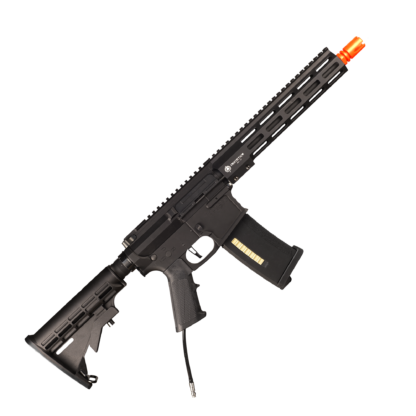
MTW Billet Series
This is the affordable chassis option.
-
CNC-machined billet receivers
-
Tight cosmetic tolerances
-
Rigid overall structure
-
Distinctive industrial finish
- Extremely lightweight
Those that like the look of modern receiver designs, want to cut weight down by every possibe ounce, and/or seek to save $150-$200 on the rifle, will appreciate the Billet series over the Forged.
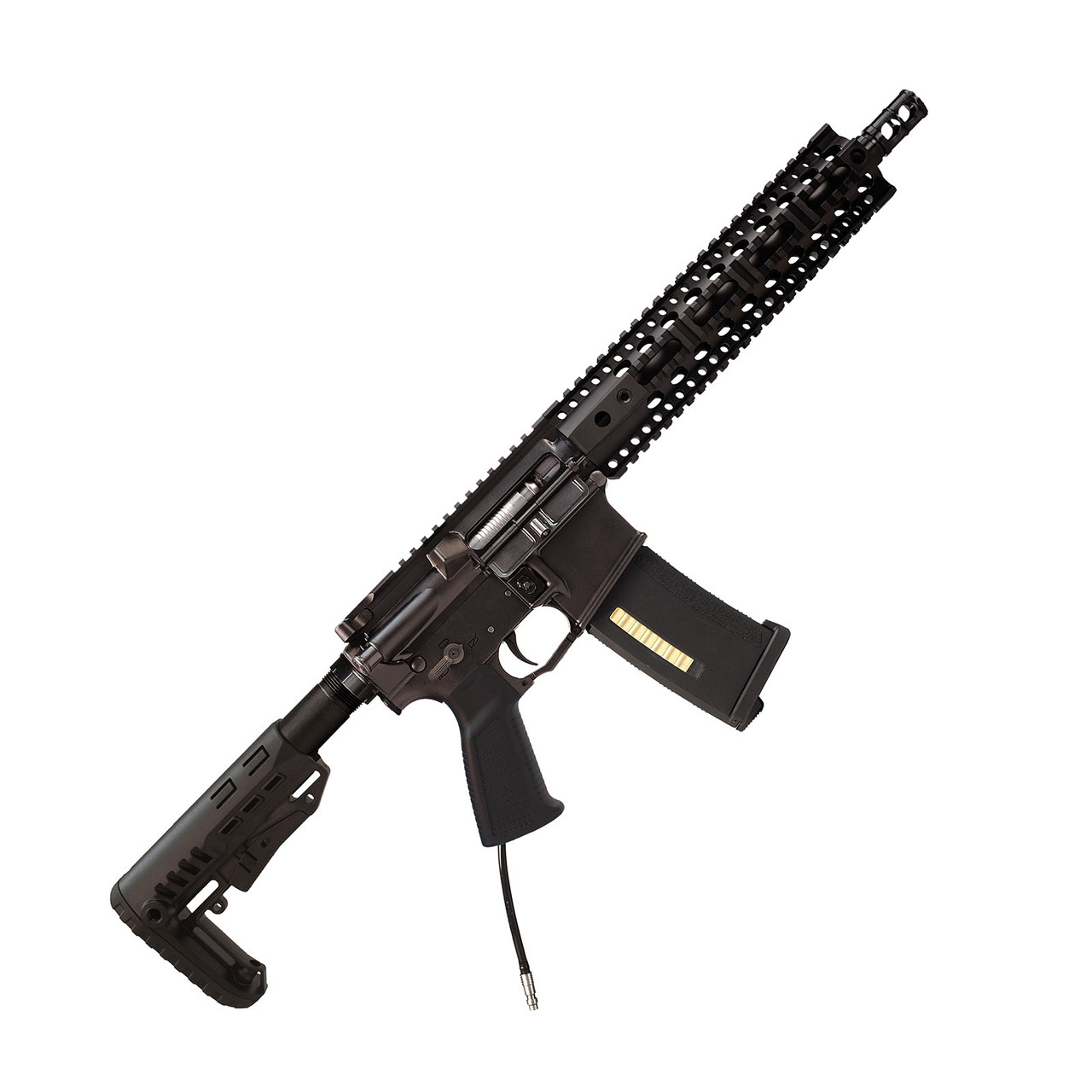
MTW Forged Series
This is the workhorse.
-
Forged aluminum receivers
-
Lightweight, notably not as light as the Billet
-
Excellent durability for field and competitive use
- Classic AR receiver stylings
-
However it is more expensive at a minium price of $885
Functionally, performance is identical between Billet and Forged MTWs, the Forged is worth the extra cost for those that want the more traditional body lines of a classic AR-15 / M4 receiver.
XB vs XBR: What’s the Difference?
What does the XB add to the MTW platform?
- Extended stroke system
- Improved Hop-Up seal enhances feeding forgivness
- Incresed seperation between loading and firing movements to help stabilize each BB for tighter groupings and more accurate shots
- New valve housing optimizes internal airflow meaning reduced air waste and improved dewll tuning tolerance
- Uses the BLINC Bluetooth to give you control of your HPA engine through an app it also provides a full time sleep mode, short detection, and battery voltage monitoring
- Automatic dwell adjustment with the use of the Acetech Bifrost BT Tracer unit
Now what about the XBR?
- All things included in the XB as well as the following
- The QUAKE MTW recoil stock provides moderate recoil but uses more air
The Cost Nobody Talks About: Time
This is where the MTW immediately wins.
Converted HPA builds cost:
-
Research time
-
Install time
-
Debug time
-
Re-tune time
-
Compatibility headaches every time you change a part
The MTW costs money upfront—but saves time indefinitely.
For experienced players, field owners, and competitive users, that time savings is worth more than minor price differences.
Final Verdict
If you compare a Wolverine MTW to a budget AEG with a slapped-in engine, yes, it looks pricey.
But that’s not an honest comparison.
When measured against a properly built, properly tuned, reliable AEG-to-HPA conversion, the MTW lands squarely in the same cost bracket—and often below it—while delivering:
-
Better reliability
-
Cleaner engineering
-
Less maintenance
-
Less frustration
The MTW isn’t a luxury item.
It’s what happens when HPA is treated as a primary design goal instead of an afterthought.